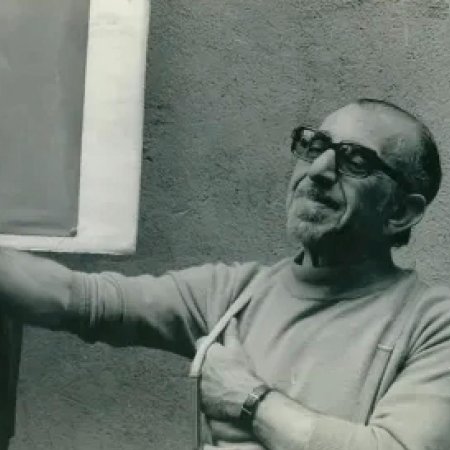
Hakkı Anlı
(1906, Istanbul – 1990, Paris)
Hakkı Anlı is regarded as one of the most characteristic representatives of the transition from figurative expression to abstraction in Turkish painting, developing a practice situated within both local and international contexts. His style—often described as “mystical” and at times “dark”—transforms his painting into not only a formal inquiry but also a space of existential exploration.
His artistic education began in Istanbul and took shape at the Istanbul State Academy of Fine Arts, in the studio of Namık İsmail (1932). Encouraged in his early years by Avni Lifij, he initially developed a practice centered on figurative work, including nudes and still lifes. This early period, however, can be understood as a phase of investigation that laid the groundwork for the abstract language he would later construct.
In the 1940s, his association with the D Group clarified his modernist orientation. This period marks a threshold in which figurative structures began to dissolve and composition gradually evolved into a more autonomous plastic construction.
With his move to Paris in 1955, Anlı’s practice underwent a radical transformation. His Paris years (1955–1990) are defined by a fully abstract language, oscillating between geometric and gestural abstraction, through which he developed a distinctive mode of expression. His contact with artists such as Jean Arp further strengthened his engagement with international artistic circles.
His works are distinguished by dense layers of color, dark tonalities that evoke a sense of depth, and surface constructions that generate an almost internal vibration. These paintings offer not only a visual experience but also an intuitive and spiritual field of perception.
His participation in major international events such as the Venice Biennale (1956) and the Bordeaux Biennale (1958) reinforced his visibility within the European art scene. Through numerous exhibitions in Paris and Switzerland, he brought his work to a wide audience.
Hakkı Anlı’s practice can be seen as a powerful example of the effort to universalize Turkish modern art through an abstract language, without severing its ties to local roots. His painting moves beyond representation, creating an intense field of visual thought that explores the internal potential of color and form.