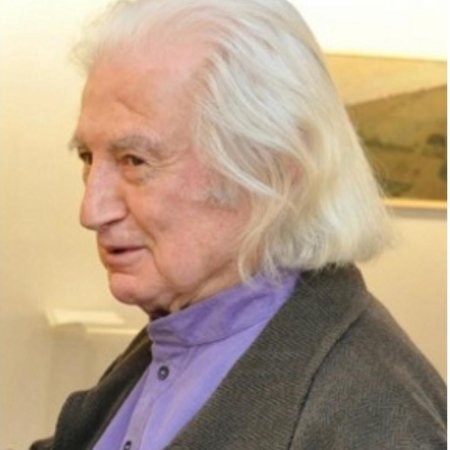
Remzi Rasa
(1928, Kırıkhan, Hatay – 2015, Paris)
Remzi Rasa can be understood as a singular figure who, throughout his life, carried into his painting the tensions between center and periphery, belonging and rupture, and individual solitude and collective memory.
Born in the Kırıkhan district of Antakya into a family with roots in a tribal structure, his childhood was shaped by an early experience of familial fragmentation. This fragile beginning formed the psychological ground for the introspective, at times harsh and raw expressive language that would later define his work. In the early 1940s, while continuing his education in Antakya, Rasa began producing his own pigments, establishing an intuitive and material relationship with painting. His first oil portrait, created in 1944, stands as a concrete indication of this early search.
In 1946, he moved to Istanbul and was admitted to the Istanbul State Academy of Fine Arts, where he studied within the academic framework shaped by Leopold Lévy, working in the studio of Bedri Rahmi Eyüboğlu. His practice of returning to Kırıkhan during the summers and continuing his studies under limited means nourished the persistent themes of labor and resilience evident in his work.
Gaining local visibility through his early exhibitions in Kırıkhan, Antakya, and İskenderun from 1947 onward, Rasa became involved in the Onlar Group between 1950 and 1952, aligning himself with the young artist movements of the period. After graduating in 1953, he moved to Paris, where he sustained his life through manual jobs while immersing himself in museums. This dual condition—intellectual engagement alongside physical labor—can be read in parallel with the directness and intensity of his painting.
A journey to the south of France in 1960 with Leopold Lévy deepened his figurative observations. In 1965, he began using the Paris studio he visited to see Fikret Mualla, and continued to work there until the end of his life; this space became both his site of production and an existential refuge. His loss of Turkish citizenship in 1966, due to not completing military service, marked a critical rupture that further sharpened his concerns with identity and belonging.
Over nearly half a century, Rasa held numerous solo exhibitions across France, as well as in Italy, Switzerland, Germany, and Turkey, establishing a dispersed yet consistent international practice. The exhibitions titled Choosing Solitude: A Retrospective (1946–2006), held in 2012 at Santralİstanbul and in Diyarbakır, offered a comprehensive reassessment of his oeuvre.
The artist passed away in Paris on 25 July 2015 and was buried in Montmartre Cemetery.
Remzi Rasa’s painting—defined by its direct engagement with material, its expressive language rooted in but not confined to figuration, and its pervasive sense of solitude—occupies a marginal yet deeply influential position within Turkish modern art. His practice stands as a powerful testament to how an artist working outside dominant narratives can persistently construct a singular visual world.