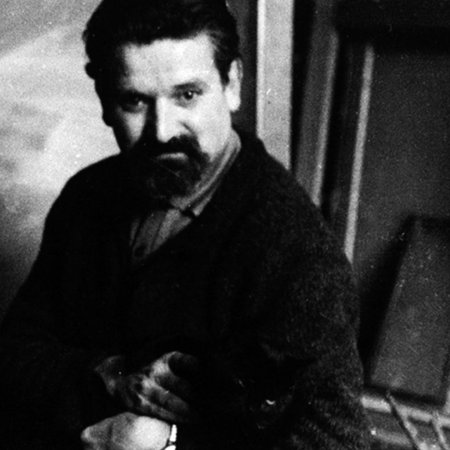
Selim Turan
(1915, Istanbul – 1994, Paris)
Selim Turan is regarded as one of the most refined figures of Turkish modern art within an international context, constructing his practice along a line of tension between geographies.
Following his education at the Istanbul State Academy of Fine Arts, he settled in Paris in 1947, permanently relocating his artistic production to Europe. Positioned within the context of the Paris School, Turan should be understood not merely as a figure of diaspora, but as a cultural translator.
While his early works present a field of exploration shaped by Impressionist and Cubist influences, his post-Paris production reveals a pronounced tendency toward abstraction. This abstraction interweaves the formal language of Western modernism with the visual and intellectual heritage of the East—particularly the traditions of calligraphy and miniature painting.
In his mature period, Turan’s practice evolved toward a surface construction in which line approaches the condition of writing, forming rhythmic and fluid compositions. At this point, painting becomes not only a field of representation, but also a layered space where temporal, intuitive, and cultural dimensions intersect.
Turan’s production extends beyond the canvas. His interdisciplinary explorations—especially in sculpture (notably mobile structures), ceramics, and mosaics—expand his engagement with space and movement.
Today, Turan’s practice is considered a critical threshold in the integration of abstract art emerging from Turkey into international circulation. His work can be defined as neither entirely Western nor solely local; rather, it finds meaning within the unique tension he establishes between these realms.