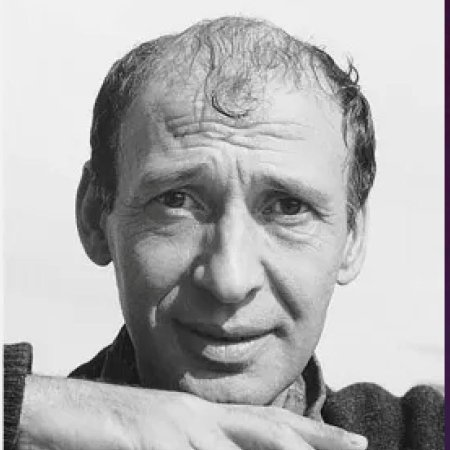
Mübin Orhon
(1924, Istanbul – 1981, Paris)
Mübin Orhon is regarded as one of the most refined abstract painters of Turkish modern art within an international context, constructing his practice through an unexpected rupture between his training in economics and his turn toward painting.
After graduating from the Faculty of Political Sciences at Ankara University in 1947, Orhon moved to Paris in 1948 to pursue a doctorate in economics. However, this path was soon abandoned as he turned fully to painting under the influence of the dynamic and transformative artistic environment of the time. His drawing studies at the Académie de la Grande Chaumière provided a technical foundation for this interdisciplinary transition.
With the geometric abstract compositions he developed in his early period, Orhon entered artistic circles in Paris and became part of an intellectual and aesthetic network through close relationships with artists such as Abidin Dino, Selim Turan, Avni Arbaş, and Albert Bitran. The acceptance of his works into the Salon des Réalités Nouvelles in 1953 and 1955 established his presence within international abstract art at an early stage.
Towards the late 1950s, his collaboration with Lucien Durand and the interest of collectors Robert Sainsbury and Lisa Sainsbury further consolidated his position within collector circles.
Orhon’s geometric abstraction is balanced not by rigid structuralism but by a lyricism that reflects the spirit of the period. This lyricism has at times been interpreted as a sensitivity “specific to the East”; the diffusion of painterly marks and the flow they establish across the surface point toward a conception of abstract landscape parallel to artists such as Sam Francis, Maria Helena Vieira da Silva, and Jean-Paul Riopelle. In Orhon’s work, this painterly network often emerges as a fragmented and layered spatial field, evoking traces of memory associated with Istanbul.
Following his return to Turkey in 1965 for military service, a marked maturation can be observed in his work. From this period onward, his practice evolved toward a color-field approach, in dialogue with artists such as Mark Rothko and Lucio Fontana. The linear interventions that characterized earlier works gradually diminished into scratches and incisions, eventually dissolving almost entirely into color.
Although this final phase is often described as “monochromatic,” Orhon’s surfaces are in fact constructed through the simultaneous presence of translucent and opaque layers, vibrating with a luminous intensity. Fragile rectangular forms open up a spatial field oscillating between presence and absence. The viewer encounters not merely a composition, but a sensorial experience of light, depth, and existence.
Mübin Orhon’s practice stands as a distinctive threshold within post-1960 abstract tendencies in Turkey, uniting formal investigation with a profound inner experience. His painting extends beyond the visual, opening an intense field of reflection on the mystery of life and light.